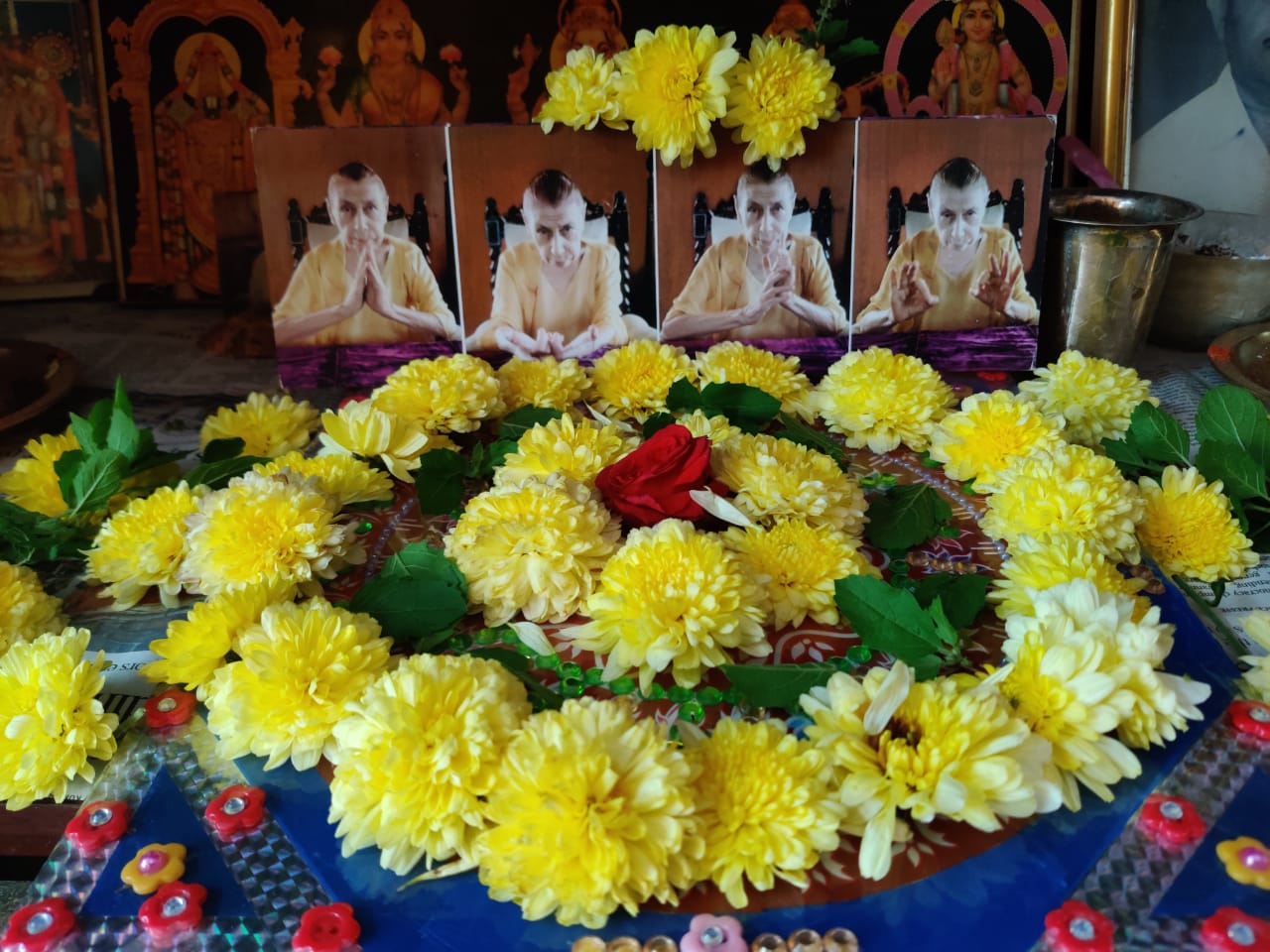
[The following account is based on Champaklal's diary.]
At last, Natwarlal, Kanri and myself arrived at Pondicherry at a.m. on April 1, 1921. Feeling that it was not proper to sit in rickshaws pulled by human beings we did not hire one. We walked the distance from the railway station to the residence of our host Narandas in Mary Street. Though it should have taken only ten minutes, it took us half an hour as we did not know the way. On reaching Narandas's house, we presented to him the letter of introduction given by Motilal Mehta. After we had our bath, we were blandly informed that there was a measles case in the house and so no meals could be served to us. I cooked my own meal, as I always did, and my companions went to Amanivasam.'
My mind was impatierit to See Sri Aurobindo and, though I attended to the daily chores, my attention was fixed there. But when we got ready to set out we were told not to go outdoors between 11.30 a.m. and 3.30 p.m. as it was scorching hot. Even dogs were not allowed to run about in the streets during that time, as it was believed that heatstroke caused rabies. We were told that unless they carried a proper collar, dogs found in the streets at this time were killed by government order.
However, we could not remain confined to the house for long and started out at 1 p.m. and came to the Guest House, where Sri Aurobindo was then staying. There we met Amrita and informed him that we had come from Bharooch in Gujarat. "Babuji is sleeping," he replied (Sri Aurobindo was addressed as 'Babuji' in those days) and told us to come back a little before 5 p.m. We said we would sit there and wait. But he told us that we couldn't sit there and must go back and come at the specified time. We felt dejected.
Then we went to the seashore and, in spite of our depression, found the place beautiful. We sat under a tree and passed some time thinking about Babuji. But we were forced to get up because of ants and went to the pier. Then with our minds still on Sri Aurobindo we went back and sat under another tree. In the cool breeze and peaceful atmosphere we were overpowered by sleep. We woke up at 3.45 p.m. and with our attention once more focussed on Babuji, came back to his temple. We sat in the verandah inside and asked Amrita for some water to drink. It was given and we eagerly quenched our thirst. I may mention here that though it was true that we were thirsty due to the climate, what made us ask for water was the desire to taste the tirtha in Sri Aurobindo's house. After Amrita had gone back we sat on. Some time later he came back and said, "Babuji is busy; I will call you." The call came at ten minutes to five.
Before that, as we were sitting in the verandah, we heard someone coming down the stairs. As soon as his foot touched the floor I spontaneously ran forward. I felt it must be Sri Aurobindo. I touched his lotus feet and prostrated myself in sashtanga dandavat pranam [with feet, trunk, shoulders, palms and head touching the floor like a rod — signifying surrender of the whole being]. Then he proceeded to the courtyard. Later I was to learn from the Mother that it was at a corresponding spot on the first floor that she had first seen Sri Aurobindo; that was at 3.30 p.m. on 29th March 1914. And I had, rather I was granted, the good fortune of meeting him just at that spot.
Page - 9
________________________________________
When we went upstairs Sri Aurobindo was seated in the verandah. I saw nothing except him and when I prostrated before him I lay there for one full hour. I just could not get up. No one disturbed me. At the end of that hour Sri Aurobindo placed his hand on my head, blessed me and said "Tomorrow." Then I got up.
A number of chairs had been placed near the table in front of Sri Aurobindo's chair. We were asked to sit there but we squatted on the floor by his side. He asked us our names and enquired about Dikshitbhai and Punamchandbhai; then he asked me: "Do you know English?" I said I did not. He began in Hindi and asked how we all had come.
C: "A group led by Dikshitbhai walked down from Bharooch to Bilimora and thence we three were sent by train."
Sri Aurobindo: "How long do you wish to stay here?"
C: "As long as you will permit us."
He looked around and smiled. Then he told us to come the next day and added that he would receive us after 4.30 p.m. He got up and we too stood up. He did namaskar and we did the same. Then he started towards his room and we remained standing till he entered it. When Amrita asked us to leave it was almost 6.10, When we left we were in a trance-like condition, our eyes could hardly remain open. No wonder we lost our way. Somehow we reached home, cooked our meal, ate it and, after some polite conversation with Narandas, still thinking of Babuji we fell asleep.
You ask me what were my reactions on my first darshan of Sri Aurobindo. Well, after getting up from my sashtanga dandavat pranam at his feet upstairs, I felt that I had nothing more to do in my life. This feeling itself was evident proof of our having 'arrived'.
The next day (2nd April), we went through the morning duties, had our afternoon rest and got ready to leave around four o'clock, but throughout our thoughts remained centred on Babuji. We reached his house and sat in the verandah downstairs. It was 4.30 but nobody came down and we became impatient for Babuji's darshan. Finally at 4.55 p.m. Amrita came and escorted us upstairs. As soon as we approached Sri Aurobindo we prostrated and our eyes touched his lotus feet. For about fifteen minutes we sat quietly, then the following conversation took place.
Page-10
________________________________________
Sri Aurobindo: "How many people are there at Kashibhai's? " He stopped after uttering Kashibhai's name. The ashram was known as Dikshitbhai' s, not Kashibhai's.
C: "Twenty and a family associated with the ashram there."
Sri Aurobindo: "What are Dikshit and Punamchand doing there?"
C: "Why do you ask that? You know everything."
Sri Aurobindo smiled and almost whispered: "Yes, I know." Then looking round at all sitting there he laughed heartily.
Sri Aurobindo: "What are you doing in yoga?"
C: "I don't know what is yoga. I am practising something taught by Dikshitbhai and Punamchandbhai. "
Sri Aurobindo: "What is the practice you are doing?"
C: "Whatever work I do I offer to the Lord and I offer it through you."
Sri Aurobindo: "How many practise yoga there? Give me their names."
I gave the names.
Sri Aurobindo: "Do you feel anything during this practice?"
C: "Yes, sometimes peace; I see at times light also."
Sri Aurobindo smiled very sweetly. Then he asked: "Yes, but has Dikshit explained to you how to dedicate everything?"
C: "No. He has only told us that we must be complete instruments. "
Sri Aurobindo: "How?"
C: "I don't know."
Sri Aurobindo: "You see, the peace which you feel shows that God is near you. The Light you see suggests that you will be able to meet him in that peace and light. Gradually you will be able to stay in this state."
C: "Sometimes I feel that the light is inside me."
Sri Aurobindo: "It means God is within you. Are you practising this?"
C: "Yes."
Sri Aurobindo remained silent for some time. Then asked "What made you come here?"
I answered in some detail.
Page-11
________________________________________
Sri Aurobindo: "Do they read any papers there?"
C: " I don't know."
Sri Aurobindo: "Do you read the Standard Bearer?"
C: "At times. When I find there something that ought to be practised I note it down."
Sri Aurobindo: "How long did you stay in Bombay?"
C: "Four days."
Sri Aurobindo: "Where did you stay?"
C: "Near Motilal Mehta's bungalow."
Sri Aurobindo: "Now what are you going to do at your place?"
C: "We have not decided yet. We are thinking of doing some farming."
Sri Aurobindo: "Someone went to Chandernagore with Dikshit. Who was that?"
C: "Dwarkanath Harkare who lived in Gandhi Ashram."
Sri Aurobindo: "Who is he?"
C: "A Maharashtrian. " (Harkare had once stayed in our study- home in Patan and taken a keen interest in me.)
It was 6.05 p.m. by now and Sri Aurobindo went into his room saying: "Now, tomorrow."
Now the third day. We got up at 6 a.m. After the day's routine we sat waiting for 4 o'clock. Our hearts were full of expectations and ardent for Babuji's darshan. Today, my mind had decided, there must be a long discussion with Sri Aurobindo; specific questions needed to be asked, and if time was too short, at least one particular one was indispensable. Joy seemed to be overflowing. But time refused to move! A thought came that we could pass the time in sleep! But today that too became difficult; finally, since we were determined, the goddess of Sleep enveloped us. After waking up we got ready quickly and set off. We went to the seashore and after a brief walk reached Babuji's temple at 4.10 p.m. Several times we sent word to Amrita. He would only say: "Babuji will see you at five. You will be called." Thereafter we tried to spend the time in japa and meditation, but it was very difficult to keep waiting. Finally we were called at 5 p.m.
After pranam when Sri Aurobindo started speaking, I said: "Please indulge us by speaking in Gujarati."
Page-12
________________________________________
He laughed and said: "I knew Gujarari when I was in Baroda but now I have forgotten it."
C: "You know everything."
He laughed and laughed.
C: "You can speak at least in Hindi."
Sri Aurobindo: "That too I don't know."
C; "You certainly know Hindi."
And then he spoke in Hindi explaining what is meditation.
During our stay of eight days, several other things happened. Sri Aurobindo asked me to try to see the Divine Shakti of the Lord that is at work everywhere, in everything. When I asked him what books I should read, he told me to read Prakriti Rahasya (Secret of Nature) in Gujarari and Shandilya's Bhakti Sutra. He explained the subject dealt with in Prakriti Rahasya and told me that it was written by a disciple of Motilal Roy of Chandernagore who lived in Navsari.* When I read that book I experienced the awakening in me of something that perceived beauty everywhere.
Once I asked Sri Aurobindo: "When will I have realisation? "
In reply he told me the following story of Narada:
Two devotees were doing their sadhana in a forest for many years. Once when Narada passed by, one of them asked him, "Bhagavan [a form of addressing holy and venerable souls], you are regularly visiting the Lord. Would you kindly ask Him on my behalf when I shall be able to get His darshan?" A little further Narada met the second devotee. He too entreated him to ask the Lord the same question. On his return Narada told the first devotee, "You will see the Lord after as many births as there are leaves on the tree under which you are doing your tapasya." The devotee was utterly disappointed and gave up his sadhana. When Narada met the second devotee and told him the same thing, he felt unbounded joy and began to dance in delight: "Oh, after all I am certain to see the Lord!" The promise filled him with such an intense joy that he lost all sense of self and realised the Lord that very instant.
Thus Sri Aurobindo described to us how the time when we will realise the Divine depends on the one-pointedness and intensity of our aspiration.
When I asked Sri Aurobindo if we could see his room, he
Page-13
________________________________________
smiled, said "Yes", and pointed towards his room. The three of us went inside unescorted. There, on his table, I saw an old pocket- watch. A thought crossed my mind that if I had the means I would get a better watch for his use and request this one for myself. The thought arose and disappeared like a sudden wave. (It had an interesting sequel. One day, after I had settled here and started working with the Mother, she brought that watch and asked me if I would like to keep it. I was amazed but did not answer because I had firmly decided never to take anything from Sri Aurobindo and the Mother, bur to offer whatever I could, All the same she gave it to me.)
We had not decided on which day we would leave Pondicherry. On the eighth day we all felt it to be the last day; for every evening, when we took leave of Sri Aurobindo after being near him for an hour, he used to say, "Now, tomorrow." But this time he said, "Whenever you meet with a difficulty, remember me", and after a pause, "Write to me." So we understood it was the last day. The wonder was that all that we wanted to ask Sri Aurobindo, all that we had to tell him, was over in the first two or three days, and yet every day, when we were leaving he used to say, "Now, tomorrow." This shows how he showered his infinite grace to keep us in his presence for some more days.